YOGA
The Origins of Yoga: A Beginner's Guide to the Ancient Philosophy and Texts

The Origins of Yoga: A Beginner's Guide to the Ancient Philosophy and Texts
Most people are introduced to yoga through the “workout” class, but yoga began as a philosophical and spiritual tradition thousands of years ago in India. Long before studios with a mural of a tree and a Sonos system existed, ancient thinkers were exploring questions about consciousness, human suffering, purpose, and the nature of reality. Over time, these ideas developed into what we now call "yoga"!
What Does Yoga Mean?
The word yoga comes from the Sanskrit root yuj, which means "to join," "to yoke," or "to unite."
Different schools interpret this differently, but common definitions include:
-
Union of body, mind, and spirit
-
Union of the individual self with universal consciousness
-
A path toward self-understanding and liberation
While modern yoga often focuses on movement, traditional yoga was primarily concerned with understanding the mind. Self-realization was at the forefront of any yoga practice, the goal to come back to our souls and higher consciousness.
The Prologue to Yogic Philosophy
The earliest roots of yoga can be traced to the Vedas, a collection of sacred texts composed between roughly 1500 and 500 BCE in ancient India.
Unlike books written by a single author, the Vedas were developed over many generations by sages and seers known as “rishis”. According to tradition, these individuals did not invent the teachings themselves but received them through deep states of contemplation and spiritual insight. The teachings were passed down orally for centuries before eventually being written down.
There are four Vedas:
-
Rig Veda: The oldest of the four Vedas, containing over a thousand hymns dedicated to various deities. It focuses on praise, prayer, and early spiritual ideas that later shaped Hindu philosophy.
-
Sama Veda: A collection of verses, many drawn from the Rig Veda, arranged for chanting and singing during religious ceremonies. It is closely associated with sacred music and ritual performance.
-
Yajur Veda: A guide for priests performing rituals. It contains instructions and mantras used during ceremonial practices.
-
Atharva Veda: A diverse collection of hymns, prayers, healing practices, and reflections on everyday life. It addresses topics such as health, protection, prosperity, and spiritual knowledge.
The Vedas were created to preserve sacred knowledge, guide religious rituals, and help people understand their relationship to the natural world, society, and the divine. They served as the foundation of early Indian spiritual and cultural life.
While the Vedas do not describe yoga in its modern form, they introduce many concepts that later become central to yoga philosophy, including:
-
Karma (action and consequence)
-
Dharma (purpose)
-
Meditation
-
Mantra
-
The interconnectedness of life
Because they established many of the core ideas that later thinkers would explore in greater depth, the Vedas provide the foundation from which yogic philosophy developed.
The Upanishads
The Upanwho’s? Written between approximately 800 and 300 BCE, the Upanishads shift the focus from external ritual to inner exploration. The Upanishads are a collection of ancient Indian philosophical texts, examining questions about the self, consciousness, reality, and liberation. Similar to the Vedas, the Upanishads were composed by various sages and spiritual teachers over several centuries and were passed down through oral tradition before being recorded in written form.
The Upanishads ask questions like “Who am I?”, “What happens after death?”, “What is reality?”. You know, the light stuff.
The importance of The Upanishads is that two integral concepts emerge from these texts:
Atman
Atman refers to the true Self, the deepest essence of a person beyond the body, thoughts, emotions, and personality.
Brahman
Brahman refers to the universal reality or universal consciousness that underlies all existence.
One of the central teachings of the Upanishads is that Atman and Brahman are ultimately one. In other words, the deepest part of ourselves is connected to the deepest reality of the universe.
Yoga Enters the Scene: The Bhagavad Gita
The Bhagavad Gita is one of the most influential texts in yoga philosophy. It is a 700-verse section of the Indian epic the Mahabharata, traditionally attributed to the sage Vyasa, who is credited with compiling and authoring much of the epic. Scholars generally believe the text was composed between roughly 400 BCE and 200 CE. The Bhagavad Gita takes the form of a dialogue between the warrior Arjuna and his charioteer Krishna, who is revealed to be a divine teacher. Through their conversation, the text explores ethics, duty, meditation, devotion, self-knowledge, and the different paths of yoga, making it a foundational work for both Hindu philosophy and yogic thought.
The story takes place on a battlefield, where the warrior Arjuna struggles with a difficult decision. His teacher, Krishna, guides him through questions about purpose, action, duty, and spiritual growth.
The Bhagavad Gita introduces several paths of yoga:
Karma Yoga
The yoga of selfless action. Act with integrity and effort, but without attachment to outcomes.
Bhakti Yoga
The yoga of devotion. Cultivating a relationship with the divine through love, prayer, and devotion.
Jnana Yoga
The yoga of knowledge and self-inquiry. Using wisdom and study to understand reality.
Dhyana Yoga
The yoga of meditation. Developing concentration and awareness through contemplative practice.
The Bhagavad Gita teaches that yoga can be practiced while fully participating in everyday life. Integrating mind, body and soul.
The Yoga Sutras of Patanjali
More big words! The Yoga Sutras are a collection of 196 short aphorisms traditionally attributed to the sage Patanjali, who likely compiled and organized earlier yogic teachings sometime between 200 BCE and 400 CE. Emerging during a period when various philosophical and spiritual traditions were developing across India, the text became the foundational work of Classical Yoga. Its importance lies in its systematic presentation of yoga as a path for understanding and calming the mind, culminating in spiritual liberation. The Yoga Sutras continue to influence yoga philosophy today and shape how many practitioners understand the deeper purpose of yoga beyond physical postures.
Patanjali's most famous definition of yoga is: "Yoga is the stilling of the fluctuations of the mind." According to Patanjali, much of human suffering comes from identifying too strongly with thoughts, emotions, and external circumstances. This led to the “Eight Limbs of Yoga”, which provide a practical framework for working with this challenge.
While modern yoga often emphasizes physical postures, the limbs guide practitioners through ethical living, self-discipline, movement, breathwork, concentration, meditation, and ultimately deeper states of awareness. Together, they offer a holistic approach to cultivating balance, clarity, and a more peaceful relationship with the mind.
The Yoga Sutras outline the Eight Limbs of Yoga:
1. Yama: Ethical principles and social conduct.
2. Niyama: Personal disciplines and self-study.
3. Asana: Physical postures.
4. Pranayama: Breath regulation.
5. Pratyahara: Withdrawal of attention from external distractions.
6. Dharana: Concentration.
7. Dhyana: Meditation.
8. Samadhi: A state of profound absorption, awareness, or liberation.
Notably, physical postures are only one part of the larger yogic system. You can see we may have lost the bigger picture in modern-day practice.
How Did Yoga Transform Into What It Is Today?
As you now know, yoga developed over thousands of years and serves as the foundation of many modern styles that we still practice today.
Tantric traditions developed between approximately 500 and 1200 CE and introduced new approaches to spiritual practice. Tantra views the body as an important part of the spiritual path rather than something to transcend. The concepts that stemmed from this include chakras, kundalini, energy work and visualization.
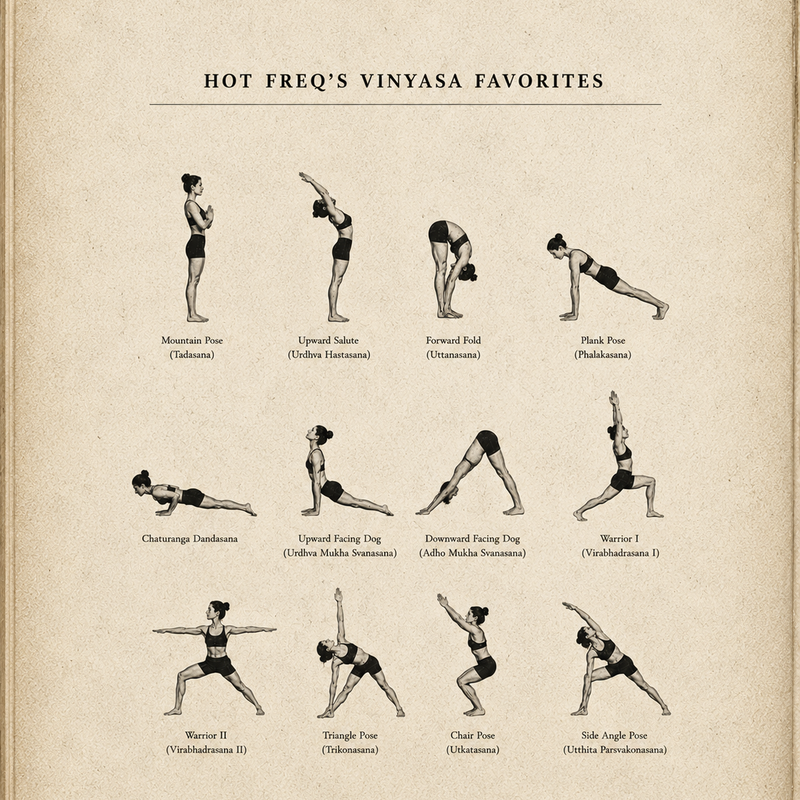
Hatha yoga emerged on the scene around 1000 CE, and placed a much greater emphasis on the physical body. This specific style of yoga is still practiced today, and influenced many modern styles that have since emerged, like Vinyasa yoga.
Although the physical elements tend to steal the spotlight in yoga practices today, all types of yoga ultimately remain focused on spiritual development rather than just fitness. This is worked in through breathwork, meditation and mantras.
Thank You, Ancient India!
We share the ancient philosophies and texts with the hope to help grow your yoga practice beyond the confines of ‘fitness’ and the physical. When we show veneration for the broader tradition of the practice, we’re able to maximize the benefits of yoga and connect to our higher selves and purpose! And - at the very least - can say you learned a few new words.
Extended Reading:
The Patanjala Yoga Sutra With Vyasa Commentary 1949 Bangali Baba